AI tools don’t cite websites based on Google rankings. ChatGPT, Perplexity, and Google’s AI Mode pull from sources that answer questions directly, stay genuinely updated, and get mentioned across the web. A page can hold the #1 spot on Google and still get skipped because its answers are buried, stale, or invisible to AI crawlers.
You did everything right. You picked the keyword, wrote the post, built the links, and watched your page climb to the top of Google.
Then you asked ChatGPT a question your page answers perfectly. And it quoted someone else.
Maybe a competitor. Maybe a Reddit thread. Maybe a site that ranks three pages below you.
So you’ve probably typed something close to “why AI doesn’t cite my website” into Google, hoping for a straight answer. Most of what you’ll find is either panic or jargon.
Neither helps you. I’ve answered this question enough times in my own consulting work to know exactly where to look, and it’s rarely where people expect.
Here’s what this post covers instead: why rankings and citations are two separate games, how AI tools actually choose their sources, the four real reasons your page gets skipped, and what to change so that stops happening.
No fluff. Just the mechanics, in plain English.
Let’s start with the part that stings.
Google ranks pages. AI quotes answers.
For twenty years, the unit of search was the page. You optimised a page, Google ranked the page, the searcher clicked the page. One question, one URL, one winner.
AI search doesn’t work in pages. It works in answers. When someone asks ChatGPT a question, it doesn’t hand them a list of ten links.
It assembles a response from fragments, a sentence from here, a stat from there, and cites the sources it pulled from. Your beautifully ranked page is just raw material.
And if your answer isn’t easy to lift out, the AI lifts someone else’s.
The data on this is blunt. According to Ahrefs’ research on AI search, only 6.82% of ChatGPT’s cited results overlap with Google’s top 10, and 83% of its answers cite URLs that don’t appear in Google’s results at all.
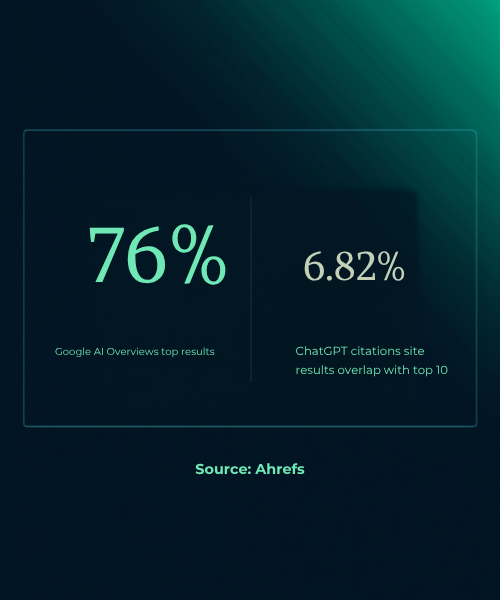
Read that again. The thing you’ve spent years competing for barely registers with the fastest growing search tool on the planet.
Google ranks pages. AI quotes answers. You’ve been optimising the wrong unit.
That’s the line to remember. Everything else in this post follows from it.
How AI search engines actually pick their sources
Not every AI tool ignores your rankings. They each play by different rules, and knowing the difference tells you where your effort actually pays off.
Google’s AI Overviews and AI Mode still lean on traditional rankings.
Ahrefs studied 1.9 million AI Overview citations and found that 76% of cited pages rank in Google’s top 10, with a median position of 3.
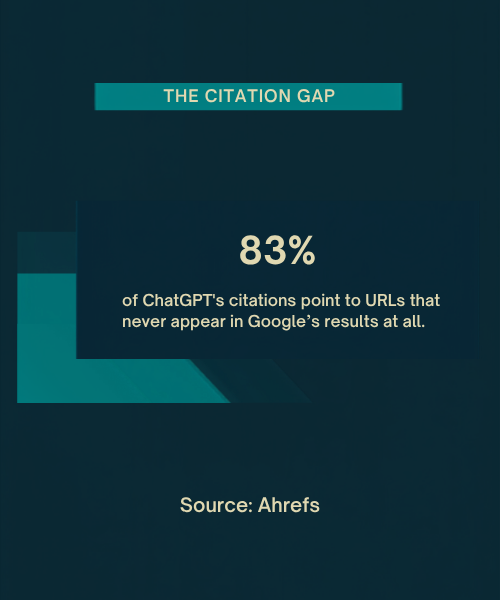
If you rank well on Google, you’re at least in the room when its AI picks sources.
But here’s the mechanism that explains the other 24%. AI tools don’t just search your keyword.
They break the question into dozens of smaller background searches on subtopics, then pull sources from each one.
Your page might rank #1 for the main query and rank nowhere for the twelve quieter questions the AI asked behind the scenes. The site that answered those quieter questions gets the citation. You don’t.
ChatGPT is a different one entirely. It runs its own retrieval, favours consensus sources, and leans hard on a handful of trusted names.
Profound analysed 680 million AI citations and found that Wikipedia alone accounts for nearly half of the citation share among ChatGPT’s ten most quoted sources.
So your competition for a ChatGPT citation isn’t just the site ranking #2.
It’s Wikipedia, industry publications, and every forum thread where your topic gets discussed. Cheerful, I know. But it’s better to know.
The real answers to “why AI doesn’t cite my website”
When I audit a site that ranks well but never gets quoted by AI, it almost always comes down to four things. Most sites I look at have at least two of them.
1. Your answer is buried. You open with a story, build context for four paragraphs, and deliver the actual answer somewhere around paragraph seven.
A human might stay for that. An AI system extracting answers won’t dig for it when another site serves the same answer in its first sixty words.
If your heading asks a question, the very next sentence should answer it.
2. Your content is stale, and AI cares more than Google does. Freshness has always mattered in SEO. In AI search, it’s close to decisive.
Ahrefs’ data shows AI platforms cite content that’s roughly 25% fresher than what appears in organic results, and 76.4% of ChatGPT’s most cited pages were updated within the previous 30 days. Your excellent guide from 2023 isn’t competing.
It’s invisible.
3. You don’t exist outside your own website. AI systems decide who to trust partly by checking who else talks about you. If your brand never appears in industry publications, comparison posts, directories, or community discussions, the AI has no external evidence you’re a credible source.
One site saying “I’m an expert” is a claim.
Ten sites saying it is a signal.
4. You’ve locked the AI out without realising it. Plenty of websites block crawlers like GPTBot in their robots.txt file, sometimes deliberately, sometimes because a developer or plugin did it years ago.
If the AI can’t read your site, it can’t cite your site. Two minutes checking your robots.txt file settles this one.
Notice what’s not on that list. Domain authority. Word count. Posting frequency.
The things that feel like effort aren’t the things that earn citations.
How to become the source AI quotes
The good news hiding in all of this: the fixes are structural, not magical. You don’t need a new website.
You need your existing content to behave differently.
Start with answer placement. Every important page should deliver its core answer in the first sentence or two under the relevant heading, in 40 to 60 words, the way this post did at the very top. Context and nuance come after.
This single change does more for AI visibility than anything else on this list.
Then reshape your headings. People ask AI tools full questions, so headings that mirror real questions give the AI a clean match between what was asked and what you wrote.
Add a proper FAQ section to your key pages with real questions people actually ask, and mark it up with FAQ schema so machines can parse it without guessing.
Update what’s genuinely worth updating.
Not the date stamp. The facts, the examples, the stats.
AI’s freshness bias means a meaningful quarterly update to your ten most important pages beats publishing ten new posts nobody asked for.
And build your footprint beyond your own domain. Guest contributions, podcast appearances, industry roundups, honest participation in communities where your customers ask questions.
Every credible external mention is a vote the AI counts.
Is it worth the effort? Seer Interactive’s analysis of 5.47 million queries found that brands cited in Google’s AI Overviews earn about 120% more organic clicks per impression than brands that aren’t cited on the same queries.
Citations aren’t a vanity metric. They’re where the remaining clicks live.
This is the work I write about every week on my blog, because it’s the work that decides who gets found over the next five years.
Final thought
Here’s the honest version of everything above. If you’ve been asking why AI doesn’t cite my website, the answer was never that your content is bad or your rankings are fake.
It’s that you’ve been winning a game whose scoreboard changed.
Rankings still matter. They’re just no longer the finish line.
The finish line is being the source an AI trusts enough to quote, and that’s built on direct answers, genuine freshness, and a reputation that exists beyond your own domain.
The sites adapting to this now will be the default answers in their niche for years. The sites waiting for clarity will be the ones nobody’s heard of, ranking #1 on a results page fewer people scroll to.
You don’t need to panic. You need to restructure. There’s a difference.
Want to know if AI is recommending you or your competitor?
If you’re not sure where you stand, I’d love to take a look. Send me a message and I’ll tell you honestly what I find, including whether it’s worth fixing and what I’d fix first.
Frequently Asked Questions
Does ranking high on Google still matter for AI visibility?
Yes, but it depends on the platform. Google’s AI Overviews pull 76% of their citations from top 10 results, so rankings still carry real weight there. ChatGPT is far less impressed, with under 7% of its citations overlapping Google’s top 10. Treat rankings as one input, not the whole strategy.
How do I check if AI tools mention my website?
Ask the tools directly. Write down ten questions your customers would genuinely ask, run them through ChatGPT, Perplexity, and Google’s AI Mode, and note who gets named and cited. If your competitors keep showing up and you don’t, you’ve found your gap.
Should I block AI crawlers like GPTBot?
Not if you want citations. Blocking AI crawlers means your content can’t be retrieved, quoted, or credited, which makes you invisible in AI answers by your own choice. Check your robots.txt file, because plenty of sites block these crawlers without the owner ever knowing.
What’s the difference between SEO and GEO?
SEO gets your pages ranked in search results so humans click them. GEO, or generative engine optimisation, gets your content quoted inside AI answers. They overlap heavily, since both reward clear structure and credibility, but GEO puts far more weight on direct answers, freshness, and mentions across the wider web.
Does schema markup help AI cite my content?
It helps machines understand your content with less guessing, which improves your odds. FAQ schema, article schema, and organisation schema all clarify what your page is and who’s behind it. Schema won’t rescue weak content, but it makes strong content easier to lift and credit.
How long does it take to show up in AI answers?
Often faster than traditional SEO, because AI platforms favour fresh content and refresh their sources constantly. A well structured page on a topic with thin competition can get cited within weeks. Competitive topics take longer, since you’re also building the external mentions that earn trust.